
Finding People Through Magna Records
The best starting point depends on what is known. A full or partial name can lead to property owners, court parties, licensed professionals, business agents, or current public officials. An address can lead first to a parcel, then to an owner and recorded deed. A date, school, cemetery, or former neighborhood can open a historical trail. Phone and email results from broad search tools are useful leads, but an official record supplies a keeper, filing date, and clearer context.
Magna became a city in May 2024. Its records did not move into one new vault. City files, contracted services, Salt Lake County records, and Utah databases still form separate parts of the search. That split makes the order of work important.
- Write down the name variants, date range, address, school, or organization already known.
- Use the free county assessment search when an owner or Magna street is involved.
- Check Utah court, license, and business indexes for records tied to a name.
- Move to deeds, vital records, probate, yearbooks, or newspapers when the trail turns historical.
- Ask the correct custodian for a specific existing record when no public index answers the question.
Confirm apparent matches with dates and record types. Two people may share a name, and an old filing may no longer reflect a current address or status.
Magna Search Offices and Custodians
Three local layers matter most. Magna keeps its council, administrative, election, and Pleasant Green Cemetery files. The Greater Salt Lake Municipal Services District holds many planning, building, code, engineering, and business-license records. Salt Lake County keeps land, assessment, marriage, election, and jail records. The Utah Judiciary and state agencies hold court, vital, corporation, license, and corrections records. The detailed access rules belong with the Magna public records system, but the offices below orient a search.
Salt Lake County Recorder
2001 South State Street, Suite N1-600
Salt Lake City, UT 84190
385-468-8145
Salt Lake County Assessor
2001 South State Street, N2-600
Salt Lake City, UT 84190
385-468-8000
Police records route to UPD, fire files to UFA, and many development files to MSD. Magna's request page identifies those referrals before a requester sends the wrong office a broad demand.
Magna Property Search Starts Free
The Salt Lake County Assessor provides the best no-cost bridge from a Magna name or street to a parcel. Search an owner as Last, First, enter at least the first three letters, or use address parts and a parcel ID. A parcel is the county's tracked unit of land. The parcel result can narrow the legal description and land record before any paid deed work begins.
| Assessor field | Best use | Format note |
|---|---|---|
| Owner Name | Find a parcel tied to a person | Use Last, First and at least three letters |
| Frontage and Street | Trace a known Magna address | Combine parts for a closer match |
| Parcel ID | Open a known land unit | Ten digits work; seven can search a block |
The official Assessor Parcel Search shows the actual owner, street, and parcel inputs used for this first pass.
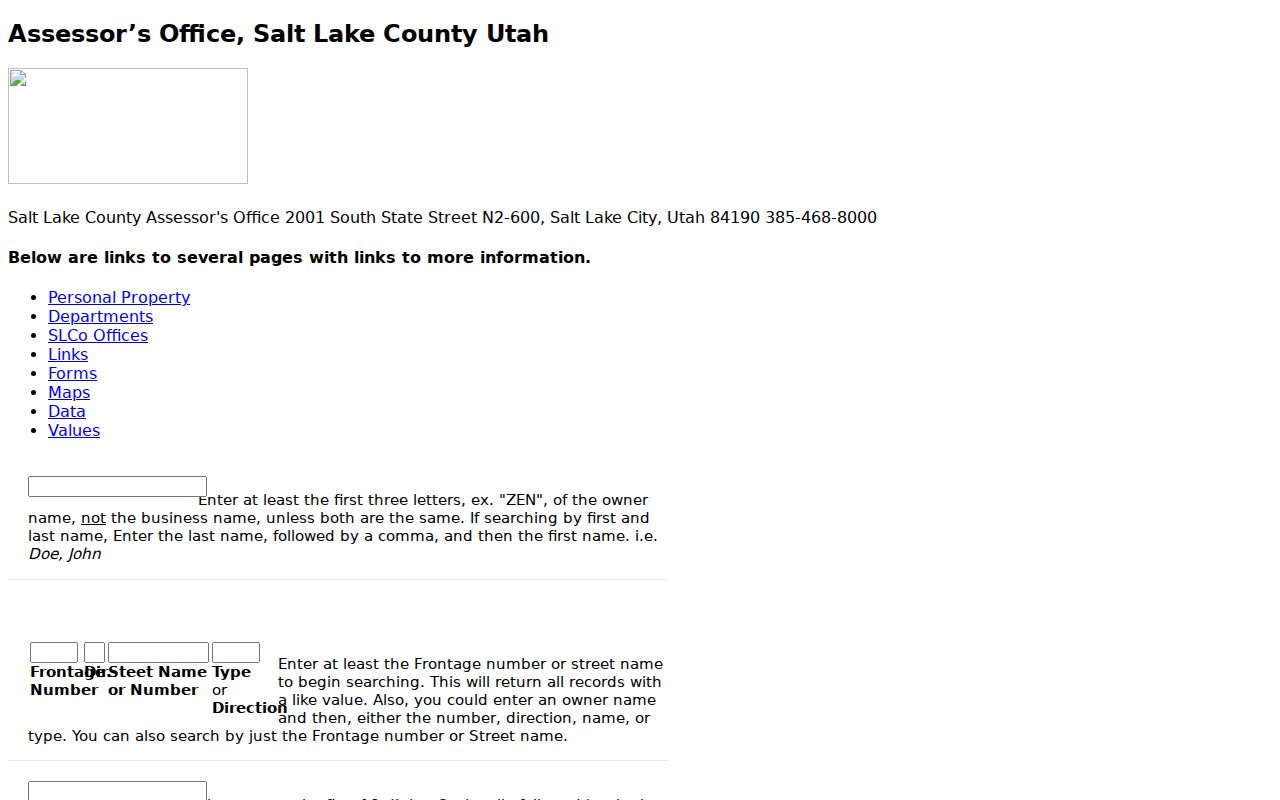
The screen helps collect parcel facts for the map, recorder, or archive without opening a paid session too soon.
Magna Deed Search Narrows Ownership
The Recorder's Data Services moves beyond current tax identification. It offers owner-of-record work, parcel-number history, legal descriptions, recorded documents, tract indexes, chain of title, subdivision maps, and plats. A chain of title is the sequence of transfers affecting the property. An occasional user pays $5 for credentials valid for 24 hours. The office does not publish the earliest online year, so the web database should never be treated as a full historical archive.
Start with the free assessor result. Copy the parcel number and legal description, then open the recorder window with a defined goal. Permanent grantor and grantee indexes remain an office or archive fallback. A grantor transfers an interest; a grantee receives it. Copies may be ordered at $2 per page, historical copies at $5 per page, or certified at $5 plus $2 per page. A certified copy bears official authentication.
The Recorder Data Services landing page lists these available property searches and the short-term access option.
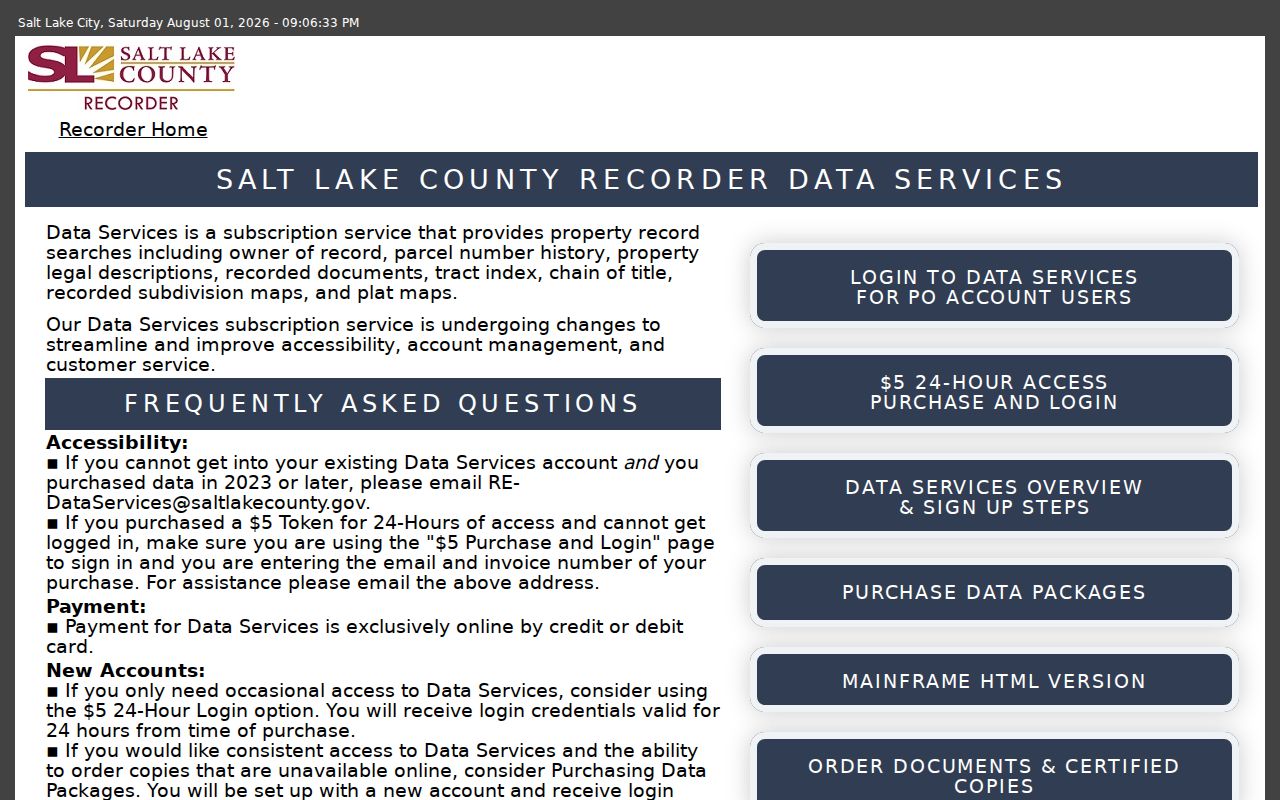
The login barrier is why parcel details should be gathered first and why the public counter remains important for older records.
Searching Magna Court Records
Magna cases may appear in Utah's Third Judicial District or a justice court. Utah Courts XChange searches public district and justice court summaries by party name, case number, court, case type, birth date when available, citation, or date range. Salt Lake City district information is complete for cases filed from December 8, 1997 forward. Earlier converted cases may be incomplete. The first two digits of a displayed case number show the filing year.
A docket is the chronological case history. It may identify parties, roles, counsel, judge, proceedings, document entries, charges, pleas, and dispositions. A disposition is the recorded outcome of a charge or case event. XChange charges $0.35 per search after initial credit and $1 for an available electronic document. Public terminals at most district courts and a clerk request are the fallbacks for public material that is missing or awkward to retrieve online.
| Court channel | Magna record scope | Access |
|---|---|---|
| Third District Court | General civil, probate, felony, and domestic matters | XChange, terminal, or clerk request |
| Utah justice courts | Lower-level criminal, traffic, and small claims | XChange; start date varies |
| District of Utah | Federal public dockets | PACER or federal clerk |
The Utah Courts XChange overview explains the official routes.
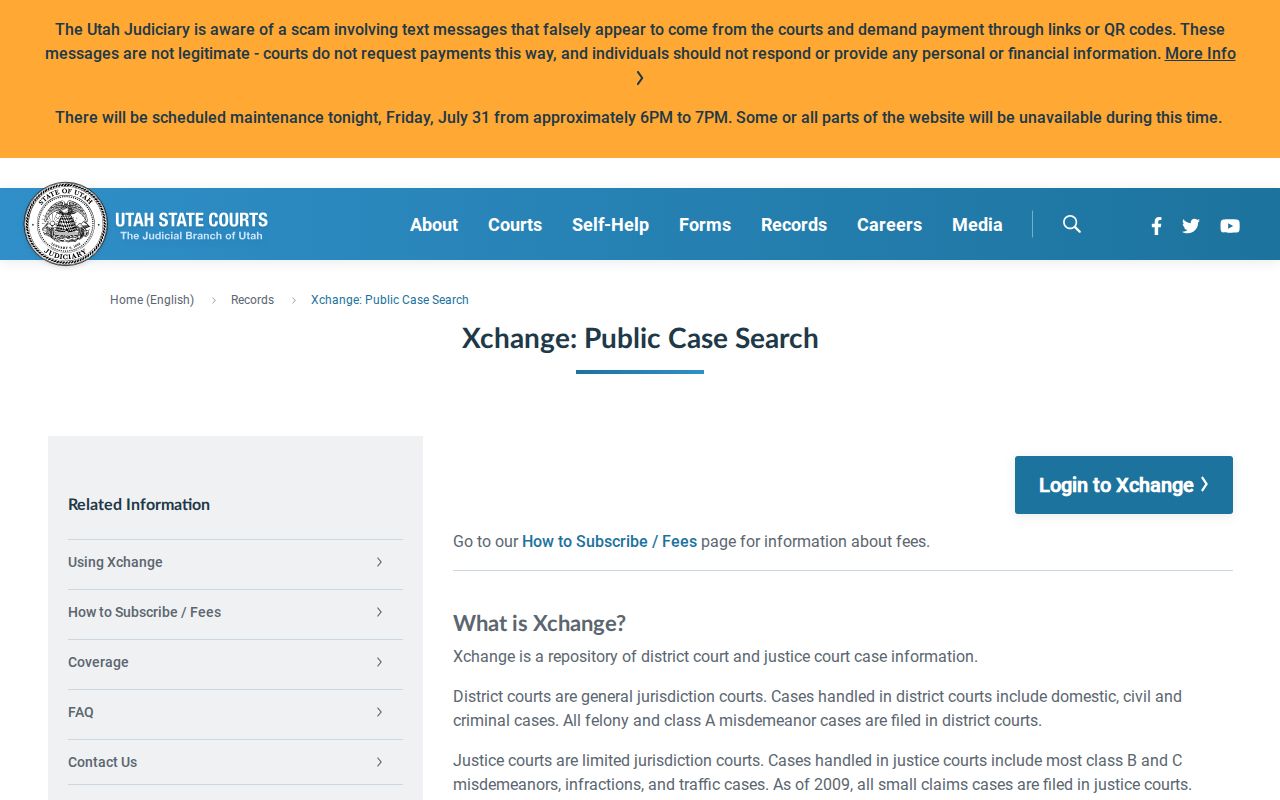
The service is a public case index, not a complete personal file. Sealed, expunged, juvenile, adoption, civil-commitment, and protected family material is omitted.
Magna Name Search With Wildcards
Names in court files are indexed as staff receive them. Exact spelling can miss a middle initial, suffix, company style, or variant. Utah Courts recommends a surname followed by an asterisk and the first few letters of the given name followed by an asterisk. Narrow the result by Salt Lake County, court, case type, or date only after testing the broader variant.
- Party
- A person or entity formally named in a case.
- AKA or DBA
- An alternate personal name or a business name used by a party.
- Expungement
- A legal process that removes the case from public display.
- Case history
- The dated list of proceedings and documents entered by the court.
A result can identify a plaintiff, defendant, petitioner, respondent, decedent, heir, or personal representative. Those roles distinguish a person named in an estate from someone in an unrelated case and help prevent a same-name mismatch.
Magna Vital Records Routes
Utah's Office of Vital Records and Statistics holds statewide births and deaths from 1905 forward. It also issues marriage and divorce abstracts for 1978 through 2010. A Magna marriage outside that range routes to the Salt Lake County Clerk. A divorce outside the state abstract period routes to the district court where it was finalized. The certificate or abstract is not the same as the court pleadings and decree.
Recent records are restricted. Births become public after 100 years, deaths after 50 years, and marriages or divorces after 75 years. Eligible applicants need identification and may need proof of family, guardianship, or legal authority. Orders can be placed online, through participating local health departments, or by mail. Mail processing requires at least six weeks.
The state vital-record ordering page sets out those routes and directs applicants to current forms.
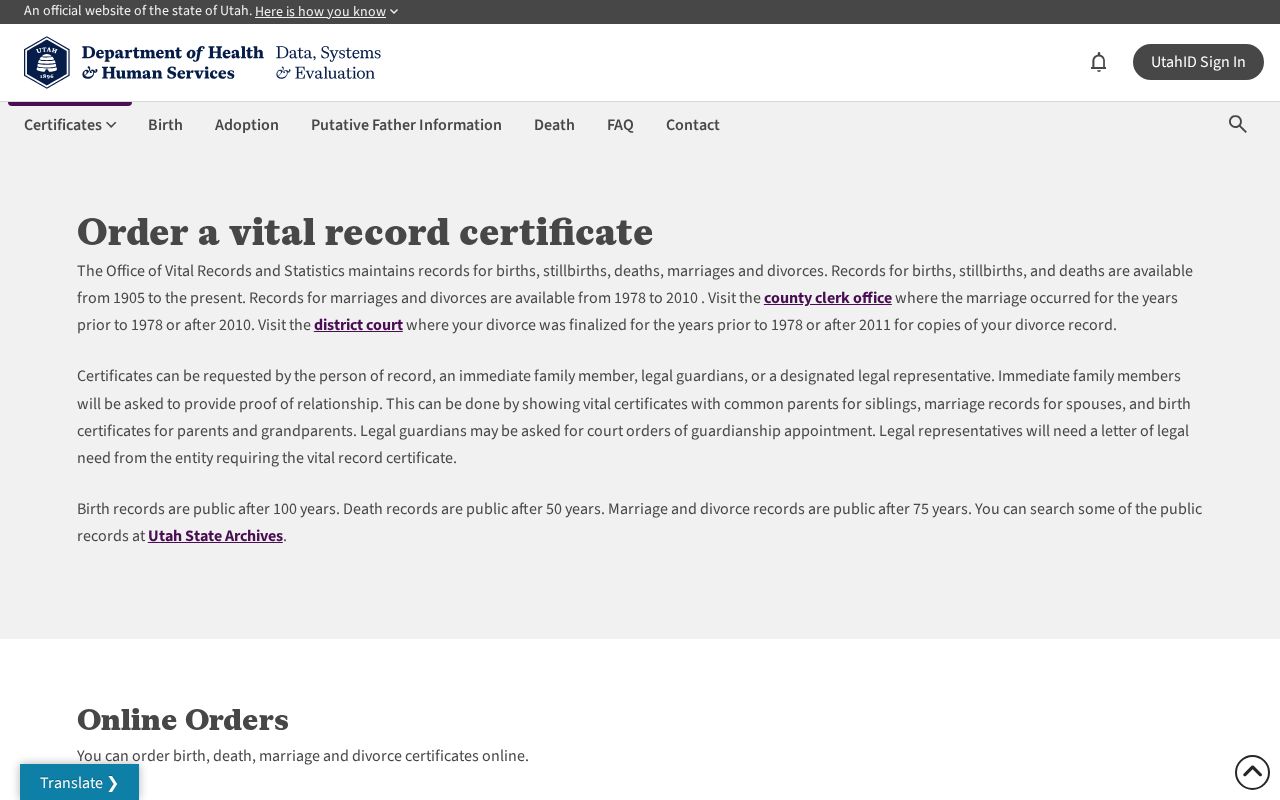
For open historical records, Utah State Archives name indexes and record guides are the discovery route rather than a modern certified-copy order.
Magna Records for Relatives
A deceased relative may appear across several lawful sources. Public death indexes can establish an event. A probate case can name a decedent, personal representative, heirs, creditors, land, and distributions. Pleasant Green Cemetery adds an unusually local source because its official grave maps and measurement database remain city-office records. There is no verified public burial-name portal, so a targeted city inquiry or GRAMA request is the direct route.
The cemetery began in 1883 and served Pleasant Green, Hunter, Ragtown, Coonville, and other west-valley families. Magna assumed ownership in 2020 after earlier church and nonprofit management. That history means staff may need to consult inherited records for older burials. Searchers can also use territorial probate indexes, digitized Salt Lake County cases from 1889 through the end of the territorial period, and open Archives vital series.
Magna Searches Need Older Names
A modern city label can hide the right historical record. Magna was called Pleasant Green before 1906. Garfield and Arthur can point to former worker settlements, while Ragtown, Coonville, Greektown, Japantown, Snaketown, and Little Italy appear in local history. Search those terms with a surname, school, mill, church, or date. A record filed under an industrial place may not surface under Magna alone.
Address history also shifts. ZIP 84044 is a mailing signal, not proof that land sits within the incorporated city line. County parcel data and the governmental-unit map settle that geography. For buildings, Salt Lake County appraisal cards and photographs cover 1934 into the 1970s, with commercial cards and images continuing through 1991. They may show owners, prior-owner references, footprints, additions, garages, sheds, or other outbuildings.
When an optical text search fails in Utah Digital Newspapers, browse issues near a known date and test the old place names. Poor print and scan quality can hide a valid surname even when the issue is online.
Magna License and Business Search
Utah's professional and business indexes help separate people with similar names. The Division of Professional Licensing supports a name search that begins with or contains the typed text, profession filters, and a direct license-number lookup. A result confirms a regulated license identity and status. It does not prove that the license holder lives at a Magna address.
The Division of Corporations searches legal entities, status, registered agents, addresses, and filings. A registered agent is the person or service designated to receive legal papers, not necessarily the owner. ChamberWest adds public member contacts for west-valley businesses, but membership is voluntary. Magna's site exposes its Business Licensing office contact without a verified public list of local license holders, so a focused city or MSD records request is the fallback.
Use each source for the fact it can prove. A DOPL entry can distinguish two people by profession and license number. A corporation filing can connect a legal business name with its designated contact and dated filing history. A ChamberWest listing can add a current public business phone or site, while its absence proves nothing about whether a firm operates in Magna. For a local license record that is not posted, describe the business name, address, license type, and date range in the request. That level of detail helps Magna or MSD staff locate an existing file without asking them to create a new report.
| Official source | What it can confirm | Limit |
|---|---|---|
| Utah DOPL | License name, type, number, and status | No published online start date |
| Division of Corporations | Entity, status, agent, and filings | Agent may not be the owner |
| Magna or MSD records | Existing local license records | No verified public name browser |
Magna Custody and Corrections Records
Custody searches must be checked in layers. Salt Lake County Sheriff's Find a Prisoner gateway covers the county jail and links dockets and rosters. The Utah Department of Corrections Offender Search covers people under state correctional supervision and expressly does not stand in for the unsentenced county population. Federal custody is yet another system. A missing result in one does not clear the other two.
Use the official source and note the update date or custody status. Police reports are different from jail custody. Some law-enforcement material is protected under GRAMA, and a general public request cannot force release of protected investigative facts. The serving agency's records custodian can identify a public incident record or explain a lawful redaction.
Note: A custody result is time-sensitive and should be confirmed with the responsible agency before anyone relies on it.
When Magna Online Records Stop
Online coverage has hard edges. The recorder does not publish its earliest index or image year. XChange can be incomplete before each court's conversion date. Cemetery maps are held at the city office. Historic property cards, probate packets, and vital series may require an archive request or visit. A portal failure should therefore trigger a better channel, not a guess that no record exists.
Use GRAMA for a defined existing administrative record. Utah accepts written requests through the Open Records Portal, email, fax, mail, or in person. Name the entity, record type, subject, date range, and preferred format. A normal response is due within ten business days unless an allowed exception applies. Filing is free, but production costs may be charged. GRAMA cannot open sealed court files, protected law-enforcement records, restricted vital certificates, or other material closed by law.
Official records and compiled search results serve different purposes. Broad results can suggest a phone, email, relative, or prior street. Government files show the source and filing context, yet they can still be old or wrong. Compare dates, roles, and locations across more than one record before treating the identity as settled.