
Search Magna Voter Registration
Utah's official Voter Search is the first stop for a current, identity-specific check. A Magna voter enters the same name and residence details used on the registration. The tool is free, but it is not an open surname browser. Every displayed identity and address input is required, and reCAPTCHA must be completed before the request is sent.
The Utah Voter Search form shows the exact inputs used for a Magna voter registration lookup.
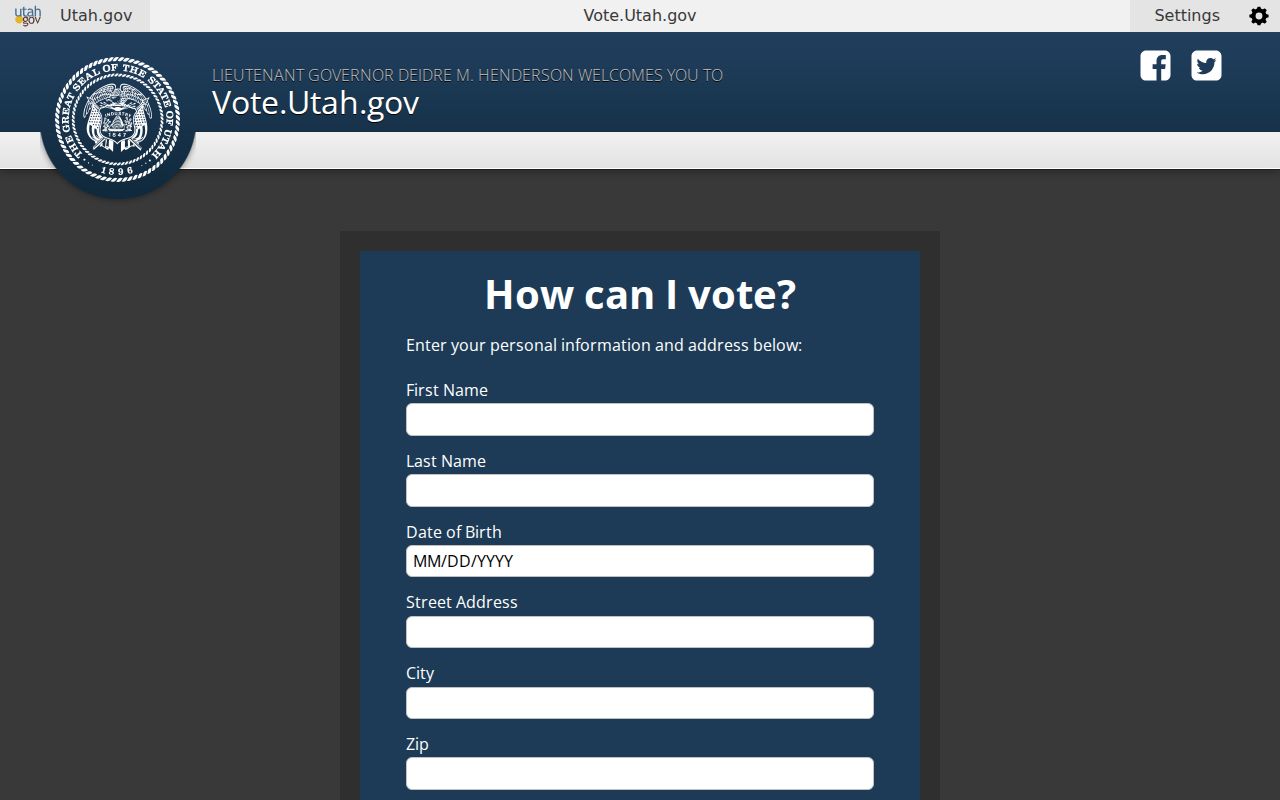
The screen separates voter-specific lookup from an address route used for polling and election information.
| Search label | Input | Required | How to enter it |
|---|---|---|---|
| First Name | Text | Yes | Use the registered first name. |
| Last Name | Text | Yes | Use the registered last name. |
| Date of Birth | Masked date | Yes | Enter the voter's full birth date. |
| Street Address | Text | Yes | Use the registered residence. |
| City | Text | Yes | Enter the registered city. |
| Zip | Masked text | Yes | Enter a five-digit ZIP code. |
| reCAPTCHA | Challenge | Yes | Complete it before selecting Submit. |
If no match appears, check spelling, birth date, and the address on file. The state message also warns that the person may not be registered or may be registered at another address. Registration and update instructions are linked from that message. For a record the tool cannot resolve, contact the county election officer rather than trying random identities.
Magna Voter Lookup Results
A successful match can return more than a yes or no. The current state application identifies the registration and places the voter in the districts that shape the ballot. Some details appear only when an election is active. No live Magna resident record was opened during research because that would require a real person's full birth date, address, and reCAPTCHA response.
| Voter status | Shows whether the current record is active or inactive. |
|---|---|
| Addresses | Shows the registered residence and, where applicable, a ballot mailing address. |
| Voting geography | Identifies the precinct and districts, including the State House district. |
| Voter ID number | Identifies the election record; it is not a driver-license number. |
| Party affiliation | Shows a registered party or unaffiliated status. |
| Election details | May include ballot status, polling place, what to bring, and candidate or issue links. |
Does voting history reveal a ballot choice? No. It records elections in which a person participated, never the candidate selected or the way any measure was marked.
Who Keeps Magna Voter Records
Magna became a city, but it did not become its own voter-record custodian. The Salt Lake County Clerk, Elections Division administers Magna voters. The Utah Lieutenant Governor's Office maintains the statewide database and sells statewide extracts. If the statewide list and county file differ, county data is authoritative.
The Salt Lake County Elections office provides the local route for questions and county or district subsets. Its office is at 2001 South State Street, Suite S1-200, Salt Lake City, UT 84190. Call 385-468-7400 or email clerk@slco.org. Counter hours can change during an election, so verify them before visiting.
The county elections landing page shows the office serving Magna and its election services.
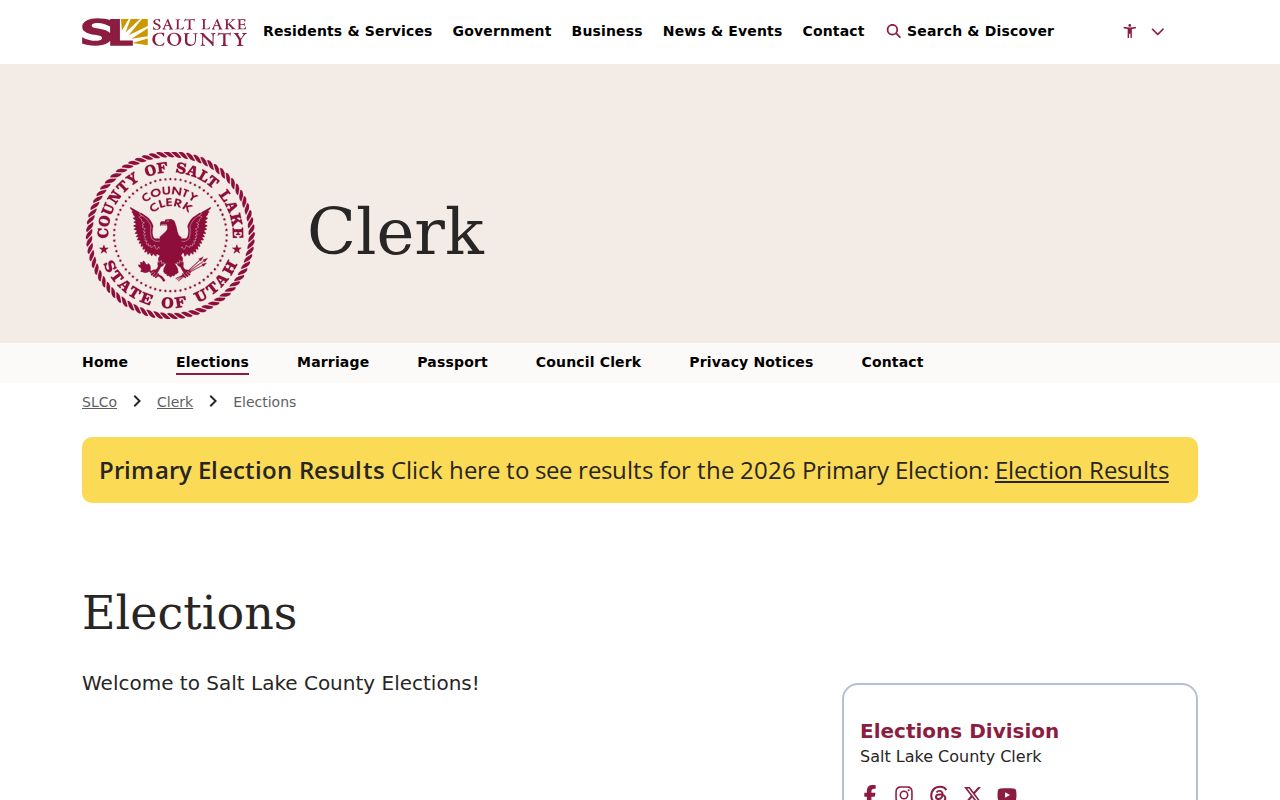
This county channel matters when the self-lookup fails, a local subset is needed, or a voter must correct a registration record.
Utah's general GRAMA framework is explained with the broader Magna public records process, but voter data has its own election-code access rules.
Magna Voter Records and Privacy
The public statewide file includes fields used to identify an ordinary voter and place that person in the right voting geography. Utah's 2026 structure uses an age range instead of a date or year of birth. Residence and mailing addresses may differ, and both must be read with the privacy exceptions in mind.
| Public-file field | What it records |
|---|---|
| Full legal name | The name held for an ordinary public voter. |
| Voter identification number | The identifier assigned to the voter record. |
| Age range | An age band, not a full birth date. |
| Residential and mailing address | The complete residence, including unit details, plus a mailing address when different. |
| Voting districts | Precinct and congressional, legislative, school-board, county-council, and city-council districts. |
| Party and status | Party or unaffiliated status, plus active or inactive registration. |
| Update and vote history | The last record-update date and elections attended. |
Confidential under Utah law. Driver-license or state-ID numbers, Social Security numbers, email addresses, full birth dates, and phone numbers are withheld. At-Risk voter identities receive added protection under current Utah Code §20A-2-602 and §20A-2-603.
False pretenses, unlawful disclosure, and prohibited use can bring criminal or civil consequences under the current statutes. Public access never permits threats, surveillance, repeated unwanted contact, or harassment. Utah's stalking law, §76-5-106.5, also applies when conduct would cause a reasonable person to fear for safety or suffer emotional distress.
Magna At-Risk Voter Protection
Utah now describes voter information in three tiers: universally protected fields, ordinary public data, and At-Risk records. The current structure followed 2026 SB 153. For an At-Risk voter, personally identifying data is anonymized. Certain reports may retain non-identifying facts such as city or county, age range, party, and vote history.
Potentially eligible people include victims of or people threatened with domestic or dating violence, law-enforcement officers, people covered by a protective order, armed-forces members, public figures, and co-residents of people in those groups. The Utah voter privacy page links the designation form and says it must be returned to the county clerk.
The form needs enough information to connect the request to the voter registration record. The state warns that omitting the name, physical address, or full date of birth can keep the county from processing it.
Note: At-Risk is Utah's current term; older descriptions of a “private voter” may not match the present rules or access tiers.
Get Utah's Magna Voter File
The Lieutenant Governor offers one statewide voter registration database purchase. Magna records sit within that file. A county or district subset is different and must be requested from the Salt Lake County Clerk. The statewide product costs $1,050 for a one-time purchase. It has no refund, subscription, or free-update option.
The state voter-data request instructions set out the product, format, price, delivery, and permitted-use terms.
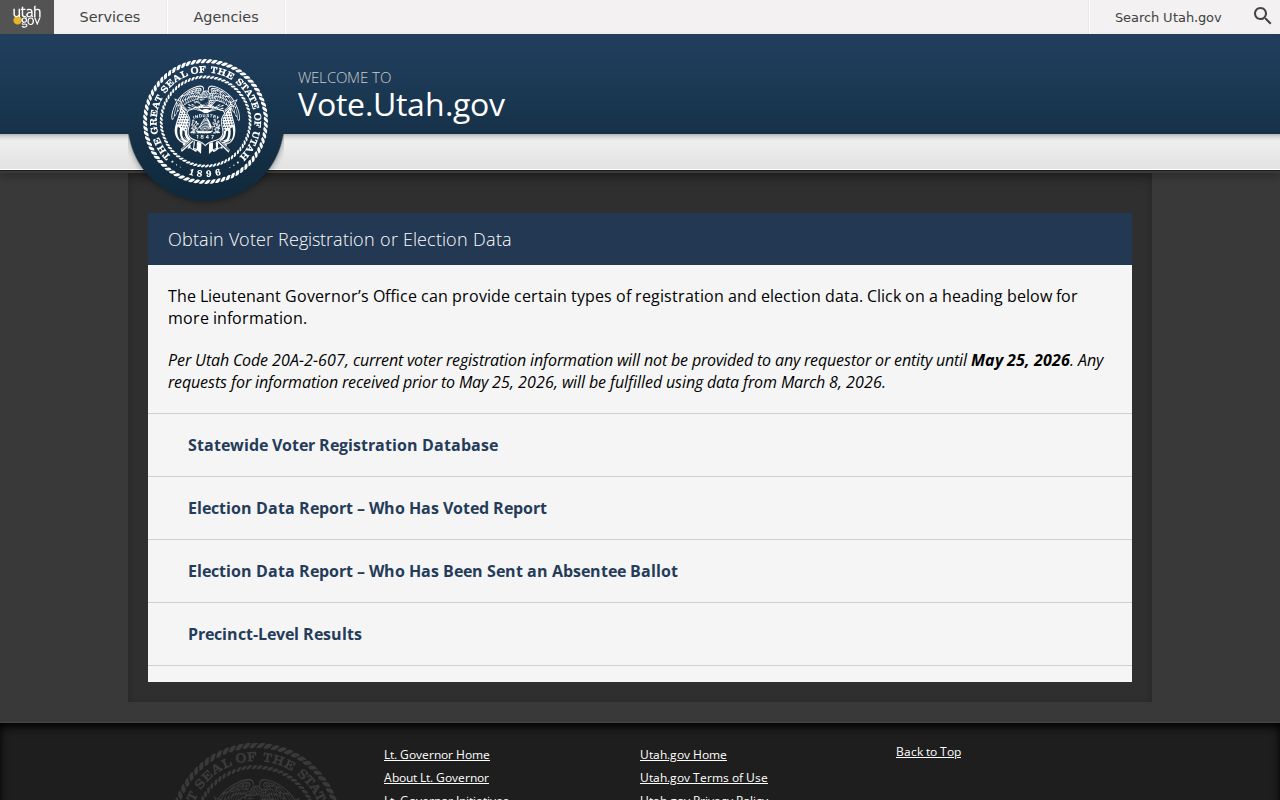
The instructions distinguish the full statewide database from county subsets and election-specific reports.
- Choose the statewide product or ask the Salt Lake County Clerk for a county or district list. Do not buy the statewide file when only a local subset is needed.
- Open the state's linked request service and complete its current eligibility and lawful-use controls. The form's conditional field labels were not available to automated inspection, so use the labels shown in the live service.
- Pay the nonrefundable fee for the statewide product. The file is about 150 MB and uses tab-delimited text, meaning tabs separate its columns.
- Watch for an emailed download link. The state says delivery occurs within one business day, and warns that some spreadsheet software may not show the entire file.
The official election-data request service is the submission channel linked by the state.
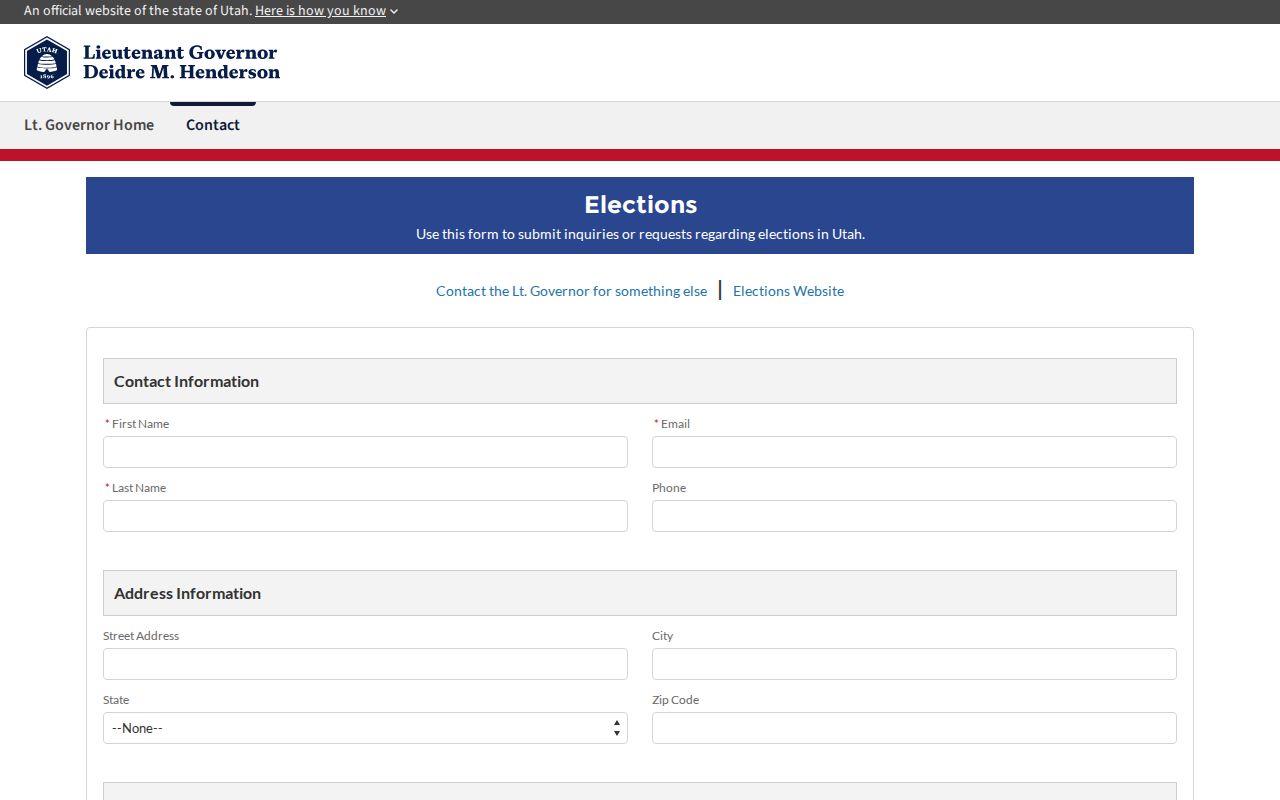
The service is the point where a requester follows the live controls rather than relying on an outdated copy of the form.
Magna Election Activity Reports
Election activity reports are separate from the full voter roll. Utah offers a Who Has Voted report and reports showing who requested or was sent an absentee or mail ballot. Each costs $35 per election and arrives as tab-delimited data during the state's stated pre-election windows.
Those reports cover regular even-year primary and general elections. They are not offered for municipal odd-year elections or after the election. Recent precinct-level results are another product available through the same request channel, with no fee stated in the research.
The split matters for Magna research. A person seeking participation data for one election does not need to treat the full statewide database as the only route. Check the product description and time window before paying.
Magna Voter Roll Maintenance
County clerks use the statewide system but certify voter-list maintenance each month. The state's voter-list maintenance rules require them to process electronic and paper registrations within seven days except between the registration deadline and canvass. They also verify identity, resolve duplicates and out-of-state registrations, remove deceased voters after notice, and send registration or confirmation cards when required.
Before each election, the Lieutenant Governor checks deceased-voter removal. Counties also certify a National Change of Address check before the main ballot extract. Each December, the annual process can mark a voter inactive after two missed general elections and no answer to a confirmation notice.
Inactive does not mean cancelled. Utah requires an additional statutory process before cancellation. An inactive Magna voter has not automatically lost eligibility solely because of that status.
The state publishes annual registration spreadsheets from 2014 through 2026, including county and party data. Salt Lake County totals may add useful context, but they must not be presented as a Magna-only count because no official city total was located.
Magna Voter File Snapshot Dates
A file date can change what a records researcher sees. Utah temporarily stopped releasing current voter information through May 25, 2026 during a citizenship review. Requests made before that date were filled from a March 8, 2026 snapshot under §20A-2-607.
That pause has ended. It should not be described as a current closure. It does explain why a file delivered during the restricted span may omit later registration changes, address updates, or status changes.
This date-specific event also shows why older voter registration summaries can be wrong. Utah recodified its voter-data rules in 2026, changed the public birth information to an age range, and established its present At-Risk structure. Current §§601 through 603 should replace citations to the superseded §20A-2-104 framework.
Historical Magna Voter Records
The current lookup does not serve as a historical surname index. For past elections, use Utah's official election-history portals and the State Archives catalog. Historical voter registers, poll lists, results, and election documents may be arranged by county, election, or record series rather than by today's city boundary.
The historical election records collection and Utah State Archives catalog are the documented online starting points. An archives catalog entry may describe a record without displaying every name or image. Contact the archives when a series requires staff help or an offline copy.
Search Salt Lake County as well as Magna. Older local references may also use Pleasant Green, the settlement's name before the 1906 change. Exact Magna poll-book and register coverage years were not found in the official online descriptions, so requesters should give the election date, county, place name, and known voter name rather than assume a complete city run exists.
Note: Current state statistics reach back to 2014, but those spreadsheets are county-level context, not a substitute for historic individual voter registers.