
Which Magna Records Are Open
Utah's Government Records Access and Management Act, known as GRAMA, classifies government material as public, private, controlled, protected, or limited. The label applies to a record, not merely to the office holding it. A public index may therefore show a case or instrument while a protected page, identity field, or sealed filing remains unavailable. Magna's recent incorporation also matters. City council, administrative, election, and cemetery files stay with Magna, while many service records remain with other bodies.
| Magna record set | Legal keeper | Online route | Practical access |
|---|---|---|---|
| Deeds, liens, plats, title instruments | Salt Lake County Recorder | Data Services, earliest web year not published | Paid 24-hour access, counter, or copy order |
| Current parcels and assessments | Salt Lake County Assessor | Free Parcel Search and Parcel Viewer | Name, address, parcel, map, print, and export tools |
| District and justice cases | Utah Judiciary and filing court | XChange; Salt Lake City complete from December 8, 1997 | Paid summary, public terminal, or clerk request |
| Birth, death, marriage, divorce | Utah OVRS, local health, county clerk, or court | No current-person public certificate index | Eligibility-based order or open archive after the cutoff |
| Professional licenses and businesses | Utah DOPL or Division of Corporations | Separate statewide name searches | Public status, agent, and filing details; agency request for other records |
| Voter information | Salt Lake County Clerk or Lieutenant Governor | Identity-based self-lookup, not an open surname browser | Public file fields subject to statutory protection |
| County jail and state supervision | County Sheriff or Utah DOC | Separate free custody lookups | Current status tools, then agency records request |
| City and service records | Magna, MSD, UPD, UFA, or county office | Agency pages and GRAMA forms | Written request to the actual custodian |
Recent vital certificates, juvenile matters, sealed or expunged cases, adoption files, specified family-case material, protected police records, and driver data are not made open by a broad request. Redaction can also leave the public parts available. Historical births, deaths, marriages, court files, and property series may become accessible through Utah State Archives even when a live portal offers no usable result.
Custodians for Magna Public Records
Magna is not the county seat. The principal land offices are at the Salt Lake County Government Center in Salt Lake City, while city-held records begin at Magna's municipal office. Court copies come from the clerk of the filing court, not the Recorder. When jurisdiction is uncertain, the record's subject gives the best routing cue: land to the county, court filings to the judiciary, and city decisions to Magna.
Magna City
8952 West Magna Main Street
Magna, UT 84044
385-977-2275
City administration, council, elections, and cemetery records
Salt Lake County Recorder
2001 South State Street, Suite N1-600
Salt Lake City, UT 84190
385-468-8145
Monday through Friday, 8 a.m. to 5 p.m.
Salt Lake County Assessor
2001 South State Street, N2-600
Salt Lake City, UT 84190
385-468-8000
Assessment roll, parcel data, and GIS
Utah State Archives
346 South Rio Grande Street
Salt Lake City, UT 84101
801-531-3848
Historic indexes and appointment-based research
The city does not act as one counter for every municipal service. Planning, code, permits, engineering, and business-license records go to the Greater Salt Lake Municipal Services District. Unified Police Department holds police files, Unified Fire Authority holds fire files, and county departments hold animal-service and street-maintenance records. This unusual split prevents a needless denial or referral.
Accessing Magna Recorder Records
The Recorder's Data Services system provides owner of record, parcel-number history, legal descriptions, recorded documents, tract index, chain of title, subdivision maps, and plats. It costs $5 for credentials valid for 24 hours, or regular users may buy prepaid data packages. The office does not publish the earliest online index or image year. Permanent grantor and grantee indexes, which list the parties transferring property, and geographic property abstracts remain important when a web search stops short.
The official Salt Lake County Recorder Data Services page shows the paid entry point and available record groups.
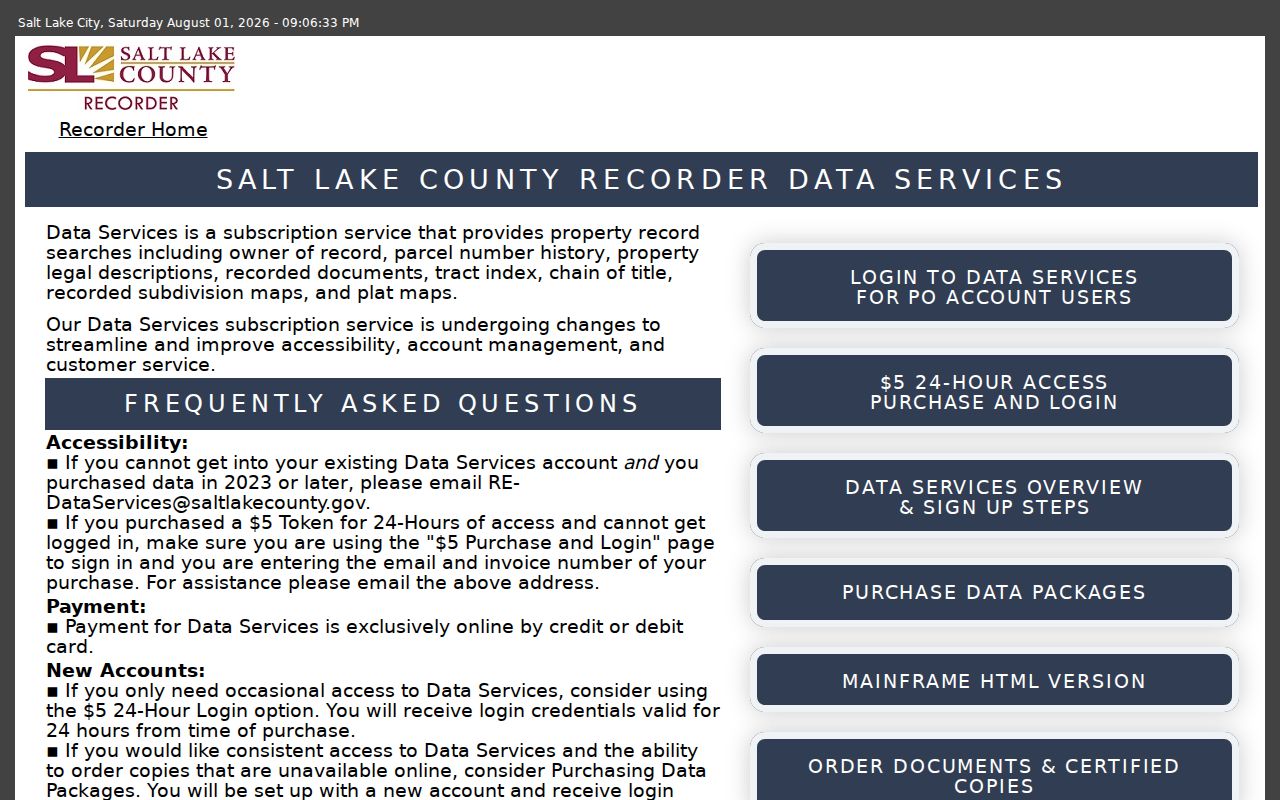
The captured portal confirms why parcel details should be collected before the short access window begins. The in-person counter, telephone, and RecorderQ@saltlakecounty.gov remain available. Email requests should put the requester's full name in the subject and include the parcel number or address.
- Index
- A finding list that points to a record by party, date, number, book, or page. It is not always the document image.
- Certified copy
- A copy carrying the custodian's formal authentication for uses that require an official version.
- Custodian
- The government entity that maintains and classifies the requested record.
- Exemption
- A law or rule that permits or requires some material to be withheld or redacted.
Search Magna Property Records First
The free Assessor search is the efficient first stop. It can turn a partial owner name, street, or parcel number into a tighter parcel reference before money is spent on Recorder access. The newer county interface also accepts owner, address autocomplete, and a formatted parcel number. Assessor data identifies the tax parcel. It does not prove the full legal chain of title.
| Assessor field | Entry type | Required | Format guidance |
|---|---|---|---|
| Owner Name | Text | No | At least three letters; use Last, First for a person |
| Frontage Number | Text | No | May begin an address search alone |
| Street Name or Number | Text | No | Supports a like-value street search |
| Parcel ID | Text | No | First 10 digits, optional four added digits; first seven can search a block |
| Parcel Details | Display choice | No | Classic page or printable view |
The Salt Lake County Assessor Parcel Search displays the official name, address, and parcel controls.
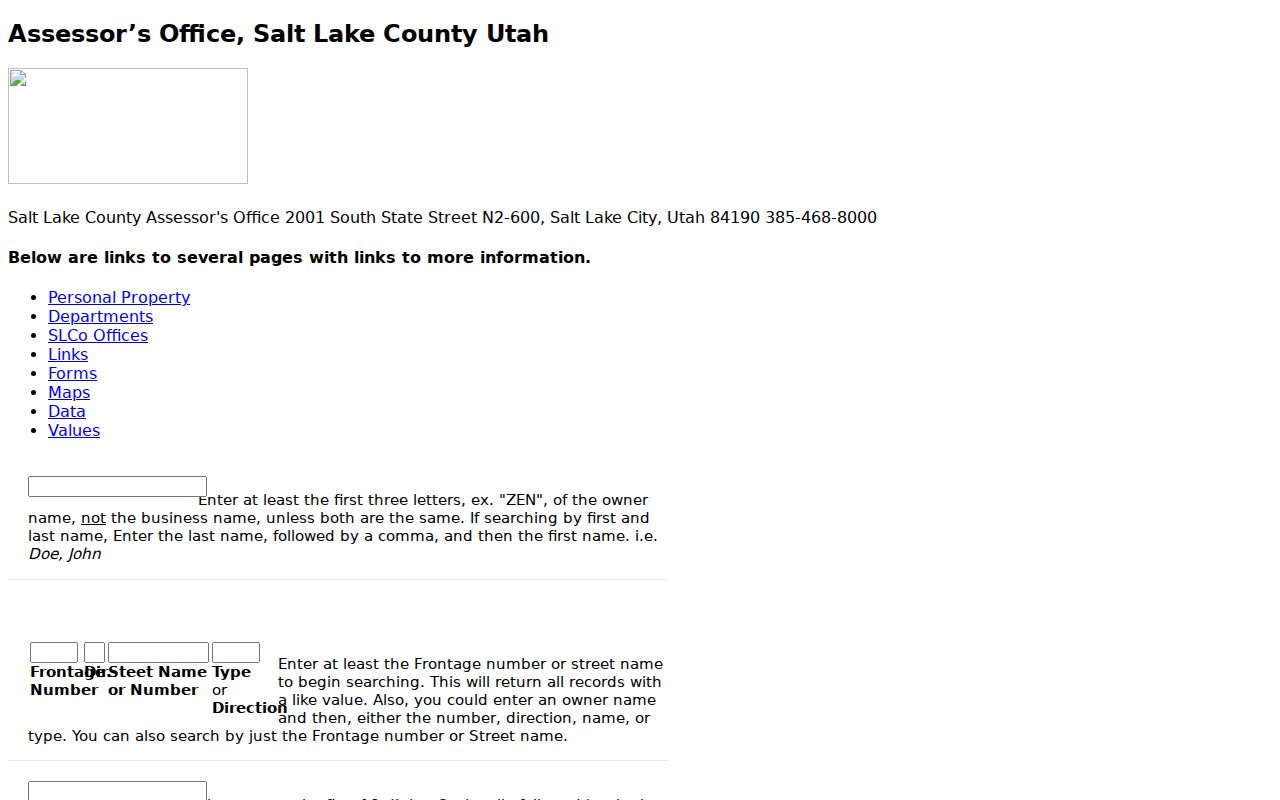
That free screen supplies the narrow identifiers needed for the paid document system. The related Parcel Viewer adds owner, property-type, tax-district, map-layer, imagery, print, and selected-feature export tools.
Insider tip. Record the parcel ID and legal description from the free assessor tools before buying the Recorder's 24-hour credential.
Magna Deeds Versus Tax History
Salt Lake County's five-year valuation history tracks assessed value at the annual final-roll closing, subject to later review changes. Recorder instruments answer a different question. Deeds, judgments, patents, claims, and other title-related filings document transfers or interests that affect possession. A parcel card can help identify where to look, but it is not a substitute for the recorded title trail.
Property Watch adds a current alert, not a title opinion. The free service emails county residents, with optional texts, when a document is attached to a registered parcel. It reports parcel number, entry number, document type, and recording date. Autocomplete must resolve the physical property address, which may differ from an owner's mailing address. A missed parcel attachment may also mean no alert.
The Recorder's Property Watch instructions show the address selection and alert process.
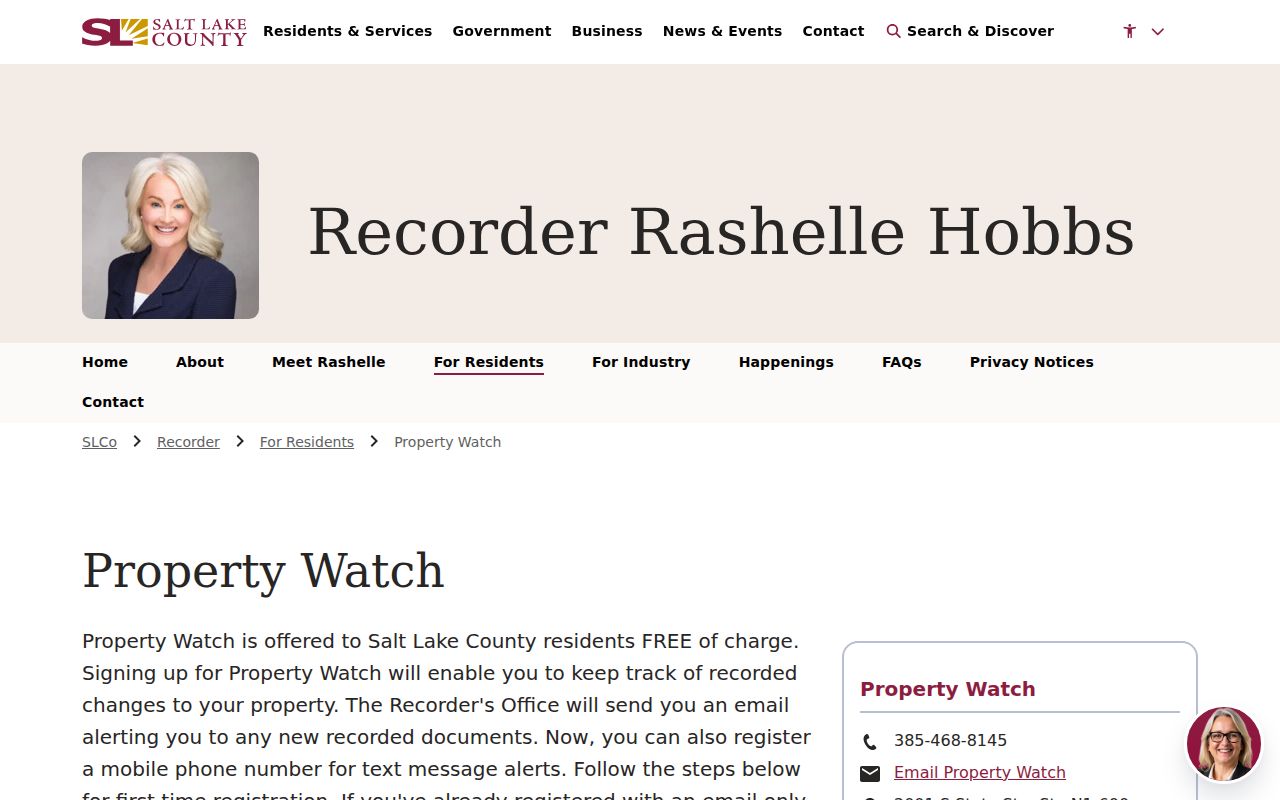
The screen reinforces the key distinction: an alert flags a new filing, while the instrument and any needed legal review determine its effect.
Magna Court Records Across Channels
Magna has no city-owned municipal court. Utah's Third Judicial District handles Salt Lake County general civil, domestic, probate, and felony matters, while justice courts handle many lower-level criminal, traffic, and small-claims cases. XChange draws public district and justice case summaries from the statewide CORIS system. Salt Lake City district information is complete for cases filed from December 8, 1997 forward, though earlier converted cases may be incomplete.
| XChange control | Type | Use | Important note |
|---|---|---|---|
| Jurisdiction | Choice | District, justice, or both | Optional |
| Last name/Company | Text | Party search | Use a trailing wildcard to catch variants |
| First Name | Text | Narrow a party | Initial letters plus wildcard can catch middle names |
| Search Scope | Selector | State, county, or court | Use Salt Lake County when appropriate |
| Case Type | Dropdown | Narrow subject | Optional |
| Date panels | Date ranges | Filing, disposition, or judgment | Useful when common names return many cases |
The Utah Courts XChange page explains account and guest access to public case summaries.
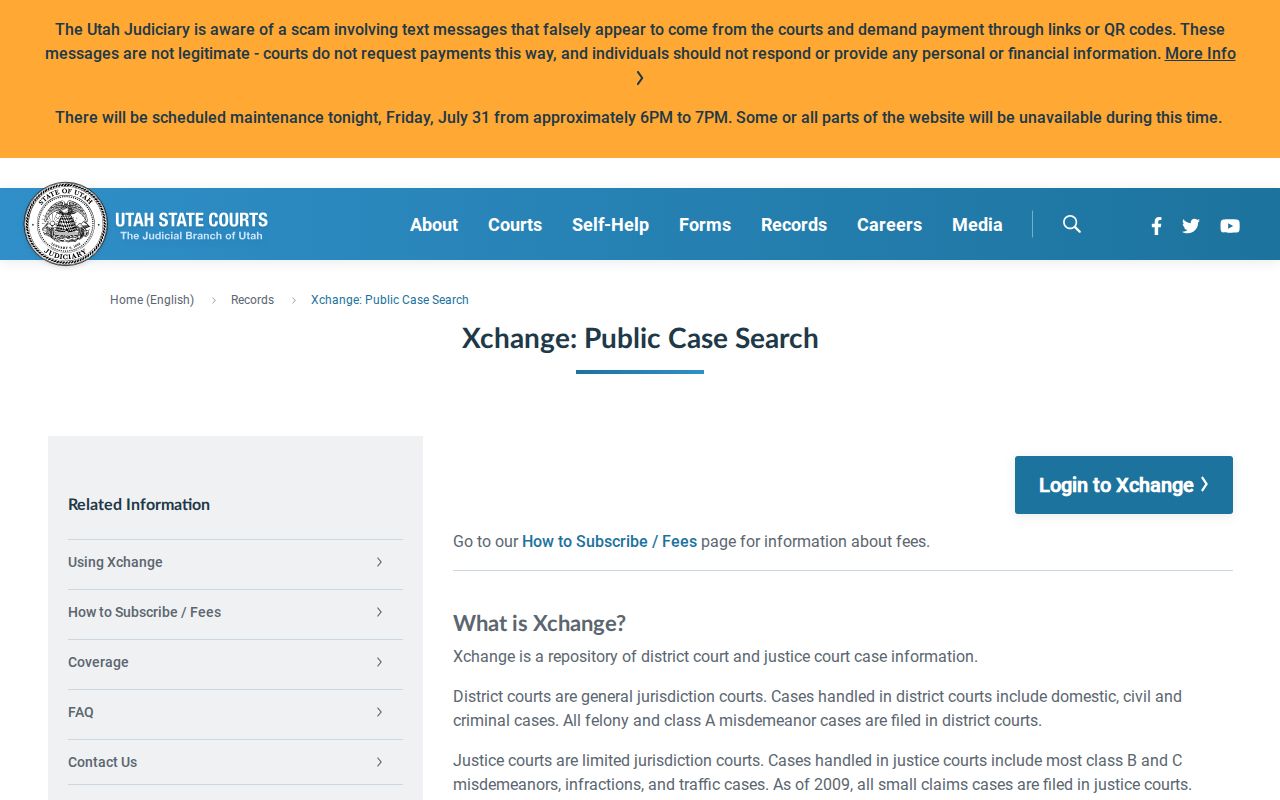
The online route charges $0.35 per search after a $10 initial credit, and available electronic documents cost $1 each. Results may identify the court, case type and number, filing date, parties, roles, and case history. Most district courthouses also offer a public terminal. Copies, certification, unavailable web documents, and archived files go through the filing court's clerk.
Magna Vital Records Have Cutoffs
Utah's Office of Vital Records and Statistics holds statewide births and deaths from 1905 forward, plus marriage and divorce abstracts for 1978 through 2010. Outside that abstract range, a Magna marriage belongs with the Salt Lake County Clerk and a divorce file or decree belongs with the court where it was finalized. A certificate abstract and a court case file are different records.
Birth records open after 100 years, death records after 50 years, and marriage or divorce records after 75 years. Restricted copies require valid identification and proof of eligibility. The state offers online ordering, local health department counters, and mail to its Salt Lake City post office box. Mailed requests take at least six weeks. State Archives name indexes and research guides are the public route once a record passes its access period.
The official Utah vital-record ordering page presents the online, counter, and mail channels.
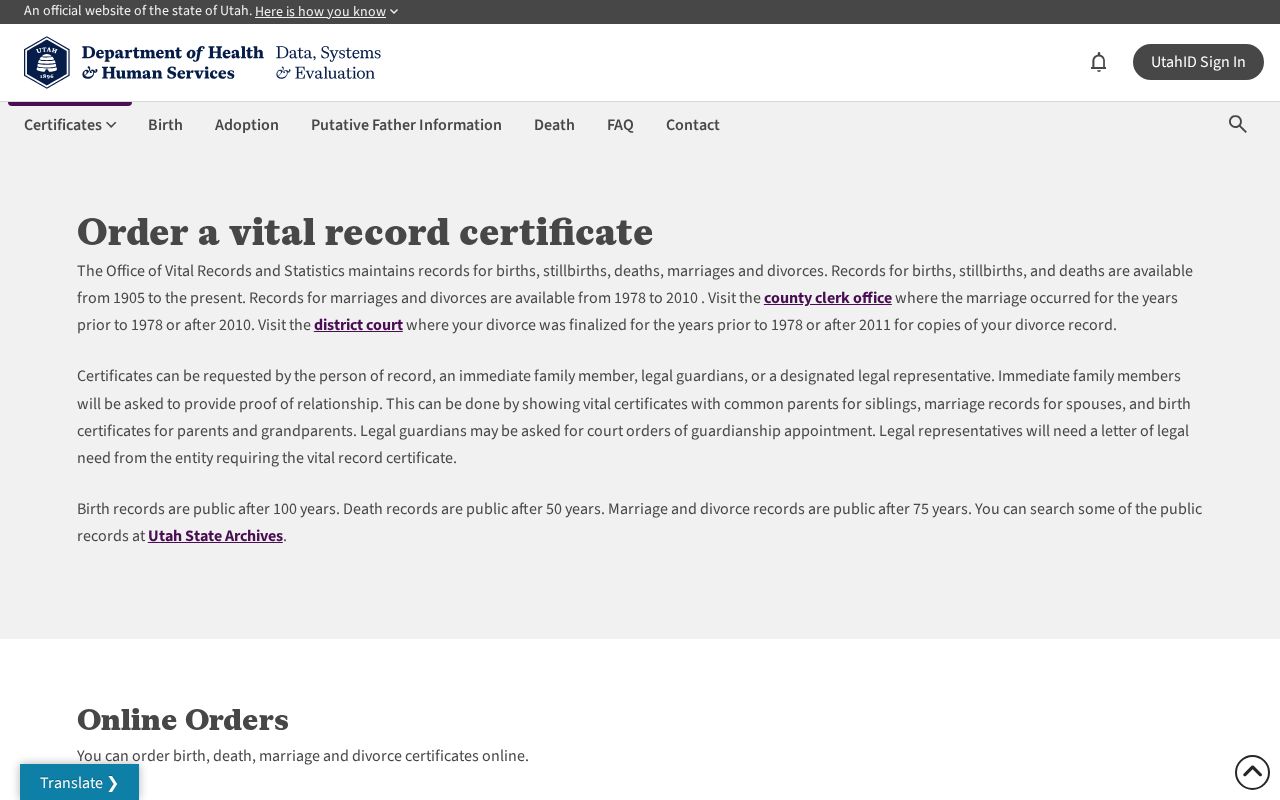
The captured page helps separate a restricted certified order from an open historical index. Current state base fees are $25 for a birth certificate, $35 for a death certificate, and $25 for a marriage or divorce abstract, with added service and delivery charges where selected.
Magna Custody Records Stay Separate
No single Utah inmate tool covers every population. Salt Lake County Sheriff's Find a Prisoner and jail docket gateway covers county custody, including people awaiting trial or not yet sentenced. Utah Department of Corrections Offender Search covers people under state correctional supervision and expressly excludes the county pretrial group. The federal Bureau of Prisons locator is a third system for federal custody.
The county Find a Prisoner gateway also separates jail rosters from statewide warrant searching. A booking entry or charge is not a conviction. Police reports and other Sheriff-held files that are not published online can be requested through the county's GRAMA portal using an incident number, date, location, involved person, and record description. Utah DOC Offender Search covers its own population, and UDC maintains a separate agency request route. Registry use must remain lawful.
Note: Verify the agency, status date, and case outcome before drawing a conclusion from any Magna custody record.
Protected Magna Records and Redactions
GRAMA does not erase privacy boundaries. Utah court rules exclude sealed and expunged cases, juvenile delinquency, adoption, child-welfare, civil-commitment, and termination-of-parental-rights matters from XChange. Parts of specified family, guardianship, protective, and related proceedings are private, though a public case history or order may remain available unless a judge directs otherwise. A custodian can redact protected material and release the balance.
Safe at Home provides qualifying survivors with a substitute mailing address and confidential forwarding for many new government interactions. It does not purge every older deed or court filing. Voter records follow their own public and protected field rules, including the current At-Risk classification. Driver records are restricted separately and are not a public name-search source. A commercial deletion request also cannot compel a Utah office to remove a lawfully public record.
Lawful personal use. Open access supports family, estate, property, safety, and civic research. It never authorizes stalking, threats, harassment, or intimidation.
Historical Magna Records Beyond Portals
Live systems do not mark the end of the record trail. Salt Lake County Archives holds residential and commercial appraisal cards from 1934 into the 1970s, commercial cards through 1991, and property photographs from 1934 through 1991. A current or former address can retrieve an owner name, prior-owner index, year built, additions, area, outbuildings, or footprint sketch. Those details often explain what a modern parcel screen cannot.
Territorial probate indexes and digitized Salt Lake County files may identify heirs, relatives, property, creditors, inventories, and distributions. Utah State Archives name indexes also route researchers to historic vital indexes, court series, and permanent land records. Magna's Pleasant Green Cemetery adds a city-held source: official maps and a measurement-based grave database remain at the city office, with no verified public name portal. A focused city inquiry or GRAMA request is the access path.
Note: Older records may use Pleasant Green, Garfield, or Arthur rather than Magna, so test the period name tied to the event.
Costs for Magna Record Copies
Use the least costly source that answers the question. The Assessor and GIS searches are free. Recorder Data Services costs $5 for a 24-hour credential. Ordinary recorded-document copies cost $2 per page, historical copies cost $5 per page, and certification adds $5 plus $2 per page. When book and page are unknown, the order should supply the abstract or index reference, line, party names, dates, and document type. Incomplete orders may not be processed.
XChange requires paid searches and separately priced electronic documents, while a clerk may charge for copies or certification under the court fee schedule. GRAMA submission itself is free, but Utah Code section 63G-2-203 permits actual production costs, staff time where allowed, duplication charges, and prepayment. An agency may waive fees when release primarily benefits the public. Ask for an estimate and choose inspection when a copy is not required.
Request Magna Public Records Precisely
A GRAMA request seeks an identifiable existing record. It does not require an agency to answer a question, conduct research, or create a new report. Utah accepts written requests from any person. Include the requester's name, address, telephone number if available, and a specific record description. State the subject, date range, office, known number, and preferred form. Save a copy because it supports any later appeal.
- Identify the custodian. Use Magna for city administration and cemetery files, MSD for development services, UPD or UFA for their records, Salt Lake County for land and jail material, and the filing court or state agency for its own files.
- Check the available index. Note coverage gaps and collect a case, parcel, entry, book, page, incident, or certificate reference when one exists.
- Submit in writing. Use the Utah Open Records Portal, agency email, fax, U.S. mail, or an in-person delivery to the records officer. Magna also offers a current city GRAMA form.
- Choose inspection or copies. Review any estimate, prepayment demand, redaction, classification, and certification need before authorizing cost.
- Track the response. The normal deadline is 10 business days, as soon as reasonably possible, unless expedited public-benefit handling or documented extraordinary circumstances apply.
- Challenge a denial when warranted. Appeal to the entity's chief administrative officer within 30 days, then use the Government Records Office route, ombudsman mediation, or district-court review allowed by GRAMA.
Magna's web form asks for contact details, a specific description, inspection or copy choice, fee-waiver basis if claimed, any entitlement to nonpublic material, expedited grounds, signature, and date. It warns requesters not to enter a Social Security number. A subject or authorized person seeking a private record must follow the city's identification and consent rules. Precision is the best way to reduce referrals, cost, and delay.